
AUST University Bangladesh is a name you will keep coming across if you are researching private universities for engineering, architecture, or business. Ahsanullah University of Science and Technology has built a reputation over three decades as one of the country’s most credible and research-active private institutions founded in 1995 by the Dhaka Ahsania Mission, with a particularly strong standing in engineering and technology.
It’s not the largest private university in the country. But it consistently ranks among the top when it comes to research output, accreditation depth, and graduate employability. This guide gives you a complete, honest picture of what AUST is its campus, programs, fees, rankings, admission process, and what it’s actually like to study there.
| Quick Facts | Details |
| Full Name | Ahsanullah University of Science and Technology (AUST) |
| Founded | 1995 by the Dhaka Ahsania Mission |
| Type | Private, non-profit university |
| Location | 141 & 142 Love Road, Tejgaon Industrial Area, Dhaka-1208 |
| Campus Size | 5 bighas (1.6 acres) — 10-storey building with 2 basement levels, 4 lac+ sq. ft. floor area |
| Programmes | 15 undergraduate and postgraduate programmes |
| Semesters | Two per year — Spring and Fall |
| Accreditation | UGC Bangladesh, IEB, IAB, ITET, BUET-recognised |
| QS Sustainability Ranking | #1501+ (2026) |
| SCIMAGO Ranking | #507 globally, #1 in Bangladesh for Engineering research (2021) |
| Country Rank | #19 in Bangladesh (uniRank 2025) |
| International Fees (Engineering) | $1,760 first semester; $1,430 per subsequent semester |
| Website | aust.edu |
About AUST The Institution Behind the Name
AUST was established under the banner of the Dhaka Ahsania Mission, a non-profit voluntary organisation founded in 1958 by Khan Bahadur Ahsanullah, a pioneering educationist and social reformer of undivided India. His legacy includes introducing the roll number system in public examinations and championing equal educational access across social groups in Bengal.
The university that bears his name carries forward that mission to produce technically competent, ethically grounded graduates who contribute meaningfully to Bangladesh and beyond.
What sets AUST apart from many private universities in Bangladesh is its deliberate focus on fewer programs done well, rather than a broad spread of departments done averagely. The university has intentionally maintained a compact academic structure engineering, architecture, and business and invested heavily in laboratory infrastructure, faculty quality, and research output within those core areas.
Campus
AUST’s main campus is located in Tejgaon Industrial Area, a fast-developing business district in central Dhaka. The campus occupies 5 bighas (1.6 acres) and houses a 10-storey building with two basement levels, covering more than 400,000 square feet of total floor area. For a private university in one of the most densely populated cities in the world, it’s a thoughtfully designed, vertically built urban campus.
Facilities include well-equipped engineering and architecture laboratories, a university library, student cafeteria, common rooms for male and female students, a university bank branch, health centre, transport fleet, and parking. In 2026, AUST inaugurated a renovated Wet Processing Lab and a new Printing and Model Making Lab for the Department of Architecture, both reflecting ongoing investment in practical, hands-on learning infrastructure.
Faculties and Departments
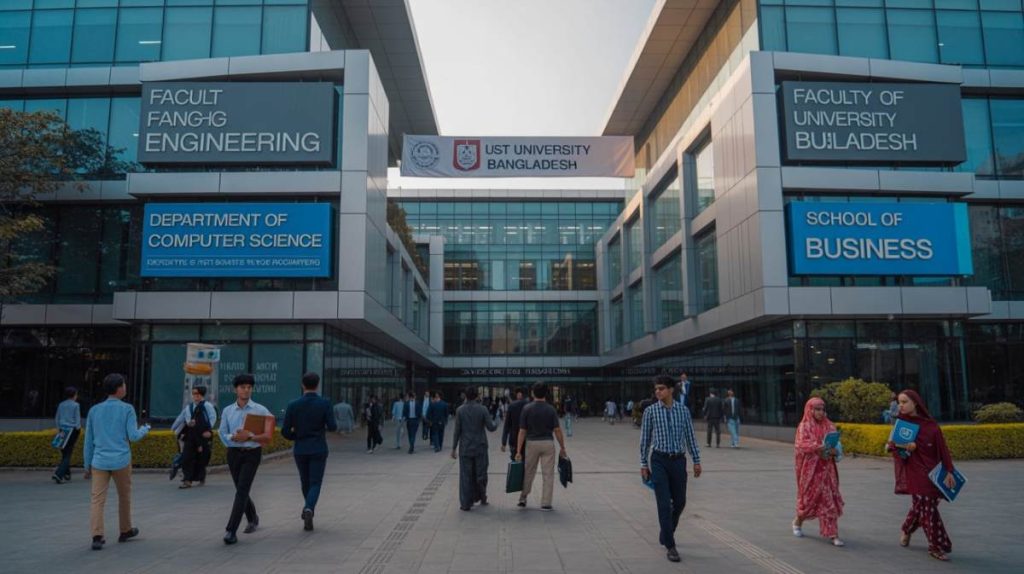
AUST operates through four core faculties, each with a focused set of departments designed around employment demand and research relevance.
Faculty of Engineering
The flagship faculty. Departments include Civil Engineering, Computer Science and Engineering (CSE), Electrical and Electronic Engineering (EEE), Textile Engineering, Industrial and Production Engineering (IPE), and Mechanical Engineering. All four-year engineering programs carry identical admission and semester fees, and all are accredited by the Institution of Engineers, Bangladesh (IEB). Graduates of AUST’s engineering programs are also eligible to pursue M.Sc. courses at BUET, a recognition that very few private universities in Bangladesh hold.
Faculty of Architecture and Planning
Offers the Bachelor of Architecture (B.Arch) a five-year professional degree and the Master of Architecture (M.Arch) postgraduate program. It is accredited by the Institute of Architects, Bangladesh (IAB). The department houses Environment and Simulation, 3D Visualization, Photographic, and Building Materials Labs. The 2026 inauguration of the new Printing and Model Making Lab has significantly expanded the department’s practical design facilities.
Faculty of Business Administration
Offers the Bachelor of Business Administration (BBA) a four-year undergraduate degree as well as MBA and EMBA programs at the postgraduate level. The BBA is the most affordable program at AUST in terms of admission and semester fees, and remains one of the most consistently popular choices among students entering through Category 3 of the admission process.
Faculty of Education
Offers two bachelor’s programs B.Ed. in Primary Education and B.Ed. in Non-Formal Education designed to produce trained educators for Bangladesh’s expanding school system. This faculty reflects the Dhaka Ahsania Mission’s founding commitment to broadening educational access at every level of society.
AUST Ranking
Ranking context matters and AUST’s position looks different depending on which system you use and what it measures.
QS Sustainability Ranking 2026 #1501+. This ranking measures environmental, social, and governance performance, a relatively new metric and one where AUST is still building its public data profile.
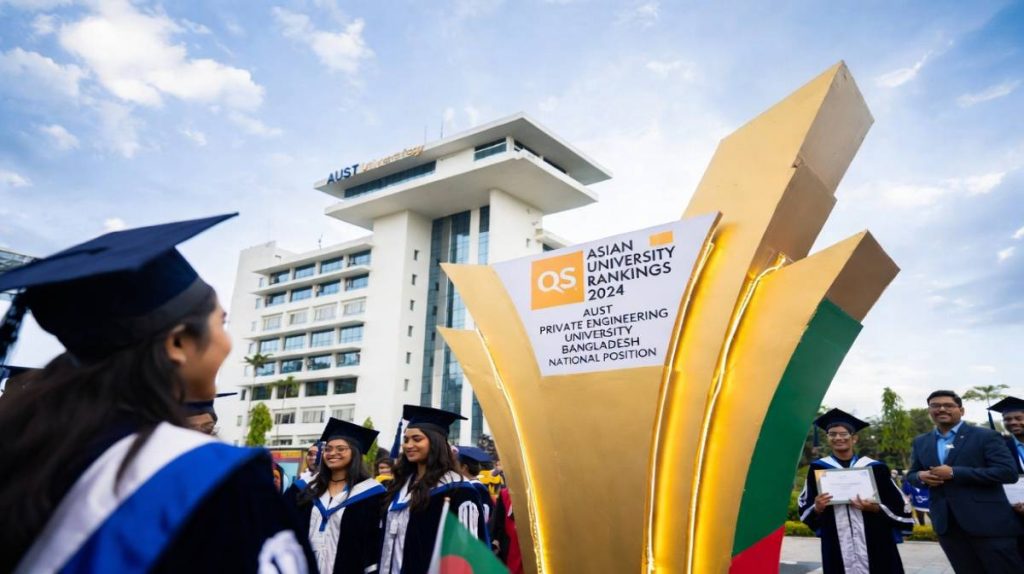
SCIMAGO Institutional Rankings #507 globally in engineering research, and ranked first among all Bangladeshi universities public and private in the engineering category. This is AUST’s most significant international recognition and reflects genuine research output published in the Scopus database.
uniRank 2025 #19 in Bangladesh overall, with a world rank of approximately 5,992 and an Asia rank of 2,212.
Bangladesh Engineering Research consistently ranked among the top two or three private universities in Bangladesh for research publication volume in engineering and technology disciplines.
The SCIMAGO ranking is the one that matters most for engineering students considering AUST it directly reflects the quality and volume of faculty-led research the university produces, which in turn shapes the quality of education delivered in the classroom.
AUST Tuition Fees and Cost
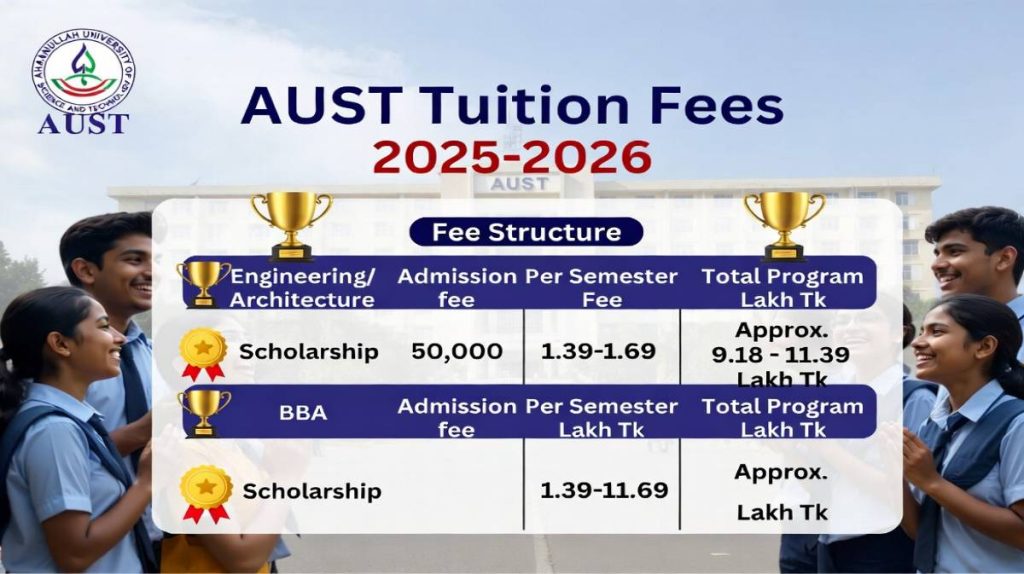
AUST operates on a semester-based fee system. Here is a straightforward breakdown of what students should expect to pay.
Local Students
Engineering programs (CSE, EEE, Civil, Mechanical, IPE, Textile) all carry identical fees a one-time admission fee of approximately Tk. 144,100 at the point of selection, plus a transport fee. Semester fees are charged per credit hour, with most engineering programs running 8 semesters over 4 years. The Bachelor of Architecture runs 10 semesters over 5 years, making it the most expensive program by total cost.
The BBA program has a lower admission fee and a lower per-semester cost, making it the most affordable undergraduate option at AUST. Always verify current fees directly at admission.aust.edu as these are updated each semester.
International Students
International students pay USD-denominated fees. For Engineering and Architecture programs, the first semester costs $1,760 and each subsequent semester is $1,430 (subject to exchange rate variation). BBA fees for international students are calculated by converting local BDT fees to USD at the prevailing rate. International students pay through the designated bank before each semester begins.
Additional Costs
Beyond tuition, students should budget an additional 10 to 20% for lab fees, library fees, examination fees, and student activity charges. There is no on-campus residential accommodation students arrange their own housing in nearby areas of Tejgaon, Farmgate, or Mohakhali, where average room rents range from Tk. 4,000 to Tk. 12,000 per month depending on type and distance from campus.
Accreditation and Recognition
- AUST’s academic programs are recognised and accredited by a wider network of bodies than most private universities in Bangladesh can claim. This multi-layered accreditation is one of its most practically significant strengths it directly affects what graduates can do after leaving.
- University Grants Commission (UGC) of Bangladesh the foundational national accreditation that makes AUST a legally recognised degree-granting institution
- Institution of Engineers, Bangladesh (IEB) accredits all engineering programs a requirement for graduates pursuing professional engineering registration in Bangladesh
- Institute of Architects, Bangladesh (IAB) accredits the B.Arch program required for architectural licensure
- Institute of Textile Engineers and Technologists, Bangladesh (ITET) accredits the Textile Engineering program
- Bangladesh University of Engineering and Technology (BUET) recognises AUST bachelor’s degrees for direct entry into BUET’s M.Sc. programs this is a particularly notable distinction
- International Association of Universities (IAU) gives AUST’s degrees international standing and recognition
- Association of Universities of Asia and the Pacific (AUAP) regional membership supporting international student exchange programs
Admission How to Apply to AUST
AUST admits students twice a year in the Spring and Fall semesters. The admission process is competitive and merit-based, with a formal admission test required for all applicants.
Academic Eligibility
For Engineering and Architecture programs minimum combined SSC and HSC GPA of 8.0, with Physics, Chemistry, and Mathematics at HSC level. O and A-Level equivalents are accepted with a minimum combined GPA of 8.0 and grades of at least C in relevant subjects. For BBA minimum combined GPA of 8.0 with good grades across maximum subjects.
Admission Test
All applicants sit for a written admission test. Engineering applicants take a Common Admission Test covering Physics, Chemistry, Mathematics, and English. Architecture applicants additionally sit a Drawing Test. BBA applicants are tested on English, General Mathematics, and ICT. The test lasts 1 hour and 45 minutes. Only shortlisted candidates based on academic results are invited to sit the test.
International Applicants
Foreign students must hold a qualification equivalent to 12 years of schooling with strong grades in relevant subjects. An IELTS score of 6.0 or TOEFL of 80 is required though AUST may waive this for applicants demonstrating adequate English proficiency. Applications are submitted online through the AUST admission portal and sent via email to regr@aust.edu. The total international student intake per semester across all programs is capped at 25 seats.
Recognition, Achievements, and Research

AUST’s strongest claim to distinction in Bangladesh’s private university landscape is its research output. Being ranked first in Bangladesh in engineering research by SCIMAGO ahead of several well-funded public universities is not a marketing claim. It’s a data-backed finding from a globally recognised research ranking body based on published, peer-reviewed output in the Scopus database.
In 2025 and 2026, AUST has continued building on this. The AUST Debating Club won the JUDO National Debate Festival 2025. The Firefly Team from AUST won the Voices for Choices Climate and Deep Tech Impact Pitch 2025.
The Department of CSE signed a technology partnership with Augmedix Bangladesh. And AUST signed an MoU with Bangladesh Institute of Management (BIM) and with Insaf Barakah Kidney and General Hospital expanding its reach into healthcare-adjacent research and professional development.
AUST also hosts the IEEE MARSCON international conference on Microwaves, Antennas, RF and Sensors, scheduled for August 2026 a signal of its growing role in international academic discourse, not just domestic education.
Notable Alumni
AUST’s alumni are spread across engineering firms, architecture practices, technology companies, and public institutions throughout Bangladesh and abroad. Given the university’s strong focus on CSE, EEE, and Civil Engineering, a significant proportion of its graduates have entered the technology sector both within Bangladesh’s growing IT industry and in international markets.
The university’s BUET recognition means many graduates have gone on to complete M.Sc. research degrees, becoming academics and researchers themselves. While AUST does not maintain a highly publicised list of named alumni in the way of larger global institutions, its graduate community is well regarded across Bangladesh’s engineering and architecture professional bodies.
Is AUST the Right Choice for You?
- If you’re seriously considering AUST, here’s an honest assessment of who it suits best.
- It’s the right choice if engineering, architecture, or technology is your field and you want a research-credentialed institution that is recognised by professional bodies in Bangladesh
- It’s the right choice if BUET M.Sc. eligibility matters to you very few private universities can offer this as a direct pathway
- It’s the right choice if you want to study in central Dhaka with an urban campus that’s well-connected to industry
- It may not be the right fit if you’re looking for a large, multi-faculty university with a sprawling campus, on-campus accommodation, or a wide range of non-technical disciplines
- The BBA program is a solid option for business students, though North South University and BRAC University have larger business school reputations in Bangladesh
Frequently Asked Questions
Is AUST a private or public university?
AUST is a private, non-profit university. It was founded by the Dhaka Ahsania Mission — a non-profit voluntary organisation — and operates independently of government funding, though it is fully accredited by the UGC of Bangladesh.
Is AUST UGC approved?
Yes. AUST is fully recognised and accredited by the University Grants Commission (UGC) of Bangladesh. Its permanent campus has also received UGC approval — a distinction not all private universities in Bangladesh hold.
How much is the BBA semester fee at AUST?
The BBA is the most affordable undergraduate program at AUST, with a lower admission fee and per-semester cost than engineering programs. The exact BDT figures are updated each semester — check admission.aust.edu for the current fee schedule before applying.
How to apply to AUST University?
Apply online through the AUST admission portal at admission.aust.edu. Submit your SSC and HSC results, sit the written admission test, and if selected, pay the admission fee through the designated One Bank deposit slip. International applicants submit documents by email to regr@aust.edu.
What is AUST’s ranking in Bangladesh?
AUST ranks #19 overall in Bangladesh (uniRank 2025) and #1 in Bangladesh for engineering research output according to SCIMAGO. In the QS Sustainability Ranking 2026 it sits at #1501+.
What programs does AUST offer?
AUST offers 15 undergraduate and postgraduate programs across four faculties: Engineering (CSE, EEE, Civil, Mechanical, Textile, IPE), Architecture and Planning (B.Arch, M.Arch), Business Administration (BBA, MBA, EMBA), and Education (B.Ed. Primary, B.Ed. Non-Formal).